The I-77 South Express Lanes project passed a few important planning and procurement milestones in February. The North Carolina Department of Transportation (NCDOT) announced a shortlist of four bid teams for the procurement, though a final RFP is now not expected until this summer. NCDOT also selected an initial design configuration for the project. On February 4th, the agency announced that “[a]fter a year-long community engagement effort…” for the project, that it was selecting an elevated express lanes design alternative, as this was considered the “least impactful design option” based on the project’s extensive community input.
The two milestones were an indication that the project, which will extend an existing express lane system another 11 miles through Charlotte to the South Carolina border, was making steady progress through both planning and procurement, after several years of preliminary evaluations. Charlotte’s Metropolitan Planning Organization (MPO) voted to approve the P3 back in October 2024, and started the present procurement with a Request for Qualifications (RFQ) last August.
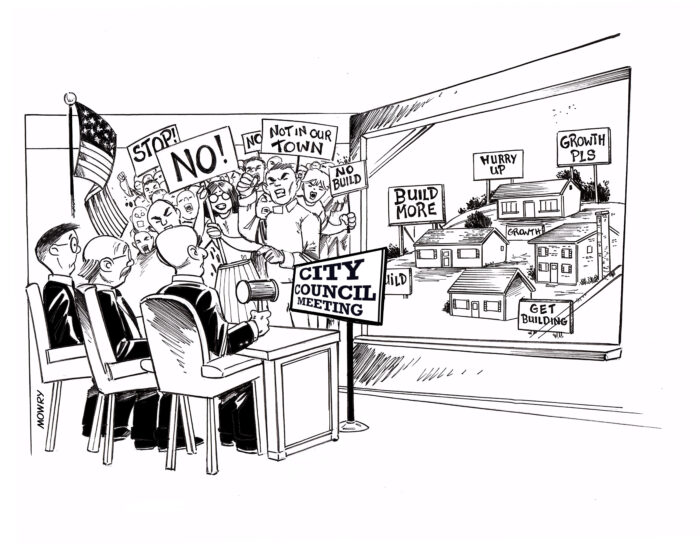
And just as the project showed momentum, the opposition arrived. In February, a campaign of local activist groups opposing the I-77 Express Lanes project emerged, and they were busy. Organized protestors have chanted slogans like “let us speak” and held signs reading “stop I-77 expansion” at NCDOT presentations and other community events around Charlotte. At a Charlotte City Council meeting in late February, so many arrived that they had to put some of them in an overflow room during the meeting. At least one lawsuit to block or delay the project has already been filed. By mid-February, a local news station was reporting that a majority of the Charlotte City Council members supported delaying the project. The Charlotte City Council just voted to approve moving forward with the P3 back in October 2024.
And just weeks after bursting onto the scene, the project’s opposition effort has already won results. NCDOT has already agreed to delay the release of its final RFP to the bid teams until June, though some preliminary information will be communicated sooner. The state has also said that it will do more compensation and study potential scope changes that would significantly increase the costs of the project, including undergrounding.
The I-77 South Express Lanes project would add two express lanes in each direction south through Charlotte. A 2024 analysis by NCDOT estimated that the project would cost $3.7 billion.
In February, NCDOT posted its shortlist of bidders for the I-77 South Express Lanes P3 with little fanfare. The shortlisted teams include:
Carolina Connectors, led by ACS Infrastructure, Kiewit, and Meridiam. The lead contractor for the team is a joint venture between Flatiron Dragados and Kiewit. The lead design team includes Arcadis and Kiewit Engineering.
I-77 Cross-State Connectors, led by Plenary, Sacyr, and Shikun & Binui. The lead contractor for the team is a joint venture between Sacyr and Shikun & Binui. The lead design team includes Dewberry Engineers and Michael Baker Engineering.
Queen City Infrastructure Partners, led by Acciona, ABP, and Balfour Beatty. The lead contractor for the team is Acciona Construction. The lead designer is Janssen & Spaans Engineering.
77SouthLink, led by Cintra, John Laing, Star America, and Aberdeen. The lead contractor for the team is a joint venture between Ferrovial and Webber. The lead designer is Rummel, Klepper & Kahl.
The I-77 South Express Lanes project is certainly not new – it has been part of CRTPO’s long-term transportation plan since 2014, and has already undergone years of analysis, planning and public consultation by NCDOT. Back in 2022, NCDOT received an unsolicited proposal for the extension project from I-77 Mobility Partners, which is the concessionaire for the existing I-77 Express Lanes network, and which is led by Cintra. That project reached financial close back in 2015 and completed construction in 2020.
NCDOT and CRTPO assessed that unsolicited proposal for more than a year (the proposal estimated that construction could be completed in 2027), before rejecting it in 2023. In 2024, however, an additional analysis from NCDOT concluded that a P3 to deliver the express lanes project was financially feasible for the state, while a publicly-delivered alternative was not. That eventually led to the project being approved by CRTPO, and NCDOT moving forward with the current procurement and environmental permitting.
Opposition Arrives

Related Articles
August 2025
I‐77 South Express Lanes RFQ Published
October 2024
I‐77 South Express Lanes Project Moving Forward
September 2024
Decision Soon on I‐77 South Express Lanes Procurement
August 2023
Unsolicited Proposal for I-77 Express Lanes Extension Rejected
February 2023
Key Vote Moves I-77 Express Lanes Project Forward