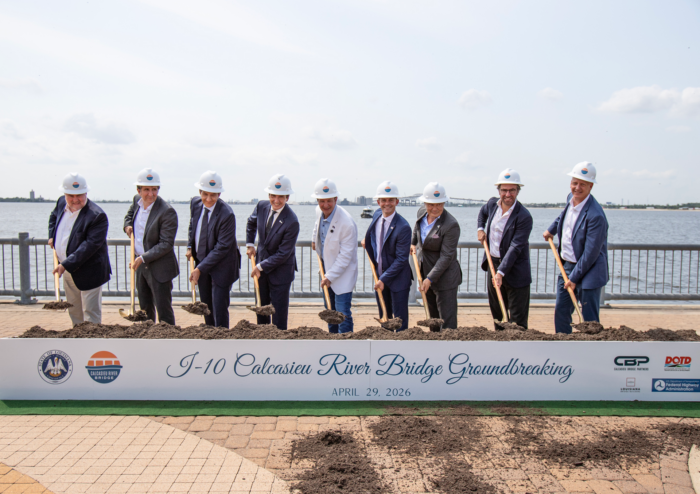
The long-awaited Calcasieu Bridge Replacement Project held a ceremonial groundbreaking in April. Now Louisiana’s Department of Transportation & Development (DOTD) and its concessionaire for the public-private partnership (P3) will finally commence major construction on a bridge replacement that has been a generation in the making. The project has years of construction ahead, but just getting this project to major construction is an achievement in and of itself.
The concessionaire for the Calcasieu Bridge Replacement Project is Calcasieu Bridge Partners (CBP). CBP is led by Plenary, Sacyr Infrastructure, and Acciona Concesiones. The design-build contractor is a 50/50 joint venture between Sacyr and Acciona. The project design team includes Huval & Associates, Arcadis, Janssen & Spaans Engineering, and Modjeski & Masters.
The Calcasieu Bridge Replacement Project will replace and demolish the existing Calcasieu River Bridge, which opened to traffic in 1952, and make additional improvements along a 5.5-mile segment of I-10 near Lake Charles, Louisiana. The bridge replacement project will be partially funded by new tolls, and the project is being delivered via a P3 with a 50-year operating concession.
“This project marks the largest transportation infrastructure investment in Louisiana history,” said Louisiana Governor Jeff Landry, who attended the groundbreaking. “This is an exciting day for Calcasieu Parish and for the entire State, and I am already looking forward to the ribbon cutting just a few years from now!”
The project’s design-build cost is approximately $2.3 billion. In addition to replacing the existing Calcasieu River Bridge, the project will add an additional lane in each direction to increase capacity. It also includes a $10 million active transportation allowance for pedestrian and bicycle improvements near the bridge. DOTD estimates that it will bring $3.29 billion in regional economic impacts and create 16,000 jobs over the project lifecycle.
CBP reached financial close for the project in August 2024. The total sources and uses amounted to $3.38 billion. Other notable uses include approximately $550 million in interest during construction and $78 million in transaction and closing costs. The project’s sources include $520 million in equity contributions, a $1.4 billion Private Activity Bonds (PABs) issuance, and $1.2 billion in milestone payments during construction.
“I’m thrilled to join our partners to get shovels in the ground for this project and make travel more convenient in Southwest Louisiana,” said Federal Highway Administrator Sean McMaster, who attended the groundbreaking.
Since financial close, CBP and DOTD have been completing preconstruction activities and design work, including geotechnical work, right of way acquisition, utility relocations, wetland mitigations and final federal permitting. The April groundbreaking marks the start of major construction for the project. The new replacement bridge is scheduled to be opened in 2031.
The start of major construction is a milestone for a bridge replacement project that feels as old as the bridge that it is replacing. DOTD started a feasibility study for the bridge replacement way back in 2001, and it started an Environmental Assessment under the National Environmental Policy Act in 2003. DOTD then decided to complete the larger Environmental Impact Statement (EIS) to study the project in 2010. After some fits and starts, that environmental study for the project was still ongoing when DOTD initiated its P3 procurement for the project in 2021. CBP was selected as the preferred bidder for the project in July 2023.
The Calcasieu River Bridge aged from roughly 50 to nearly 75 years old during that predevelopment process. Both President Trump (during his first term) and President Biden have held events at the bridge highlighting the need to invest in American infrastructure. April’s groundbreaking marks the end of one saga and the beginning of another.
A Near-Cancellation
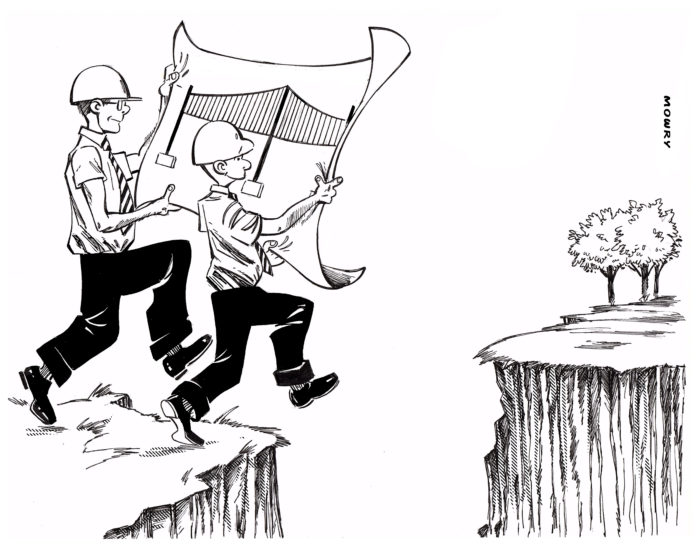
The Calcasieu Bridge Replacement was not exactly smooth sailing once the P3 procurement and environmental studies were completed. For a few months in 2023 and early 2024, the P3 was completely cancelled, before a renegotiated version of the project was revived and approved by the state.
In October 2023, the Louisiana Joint Legislative Committee on Transportation, Highways and Public Works Committee voted to cancel the Calcasieu Bridge Replacement P3 outright, long after the procurement was complete and as CBP and DOTD had nearly finalized the concession. As it neared the finish line, the project was subjected to a concerted anti-toll campaign from various stakeholder groups, including the trucking industry.
Project opponents also argued that perhaps the federal government would provide funding for the project without tolls were the P3 to be cancelled.
After the committee vote, the project seemed cancelled, but CBP was able to resuscitate it a few months later after negotiating new project terms with the Governor Jeff Landry’s administration, which had just taken office.
Under the new deal terms, toll rates for trucks were significantly reduced, and the eligibility for the local vehicle toll rate was also expanded (under the concession terms local bridge users pay an extremely low toll rate). The state was also granted an “equity” position of approximately 15% in the project, such that it would receive a portion of the project’s profits as a public contribution.
Those changes in toll revenue were partially offset by some interest rate savings and from other potential savings from design changes. DOTD Secretary Joe Donahue estimated at the time that an additional $409 million in public funding would be needed to offset the toll revenue changes from the renegotiated concession.
Tolls, for Now
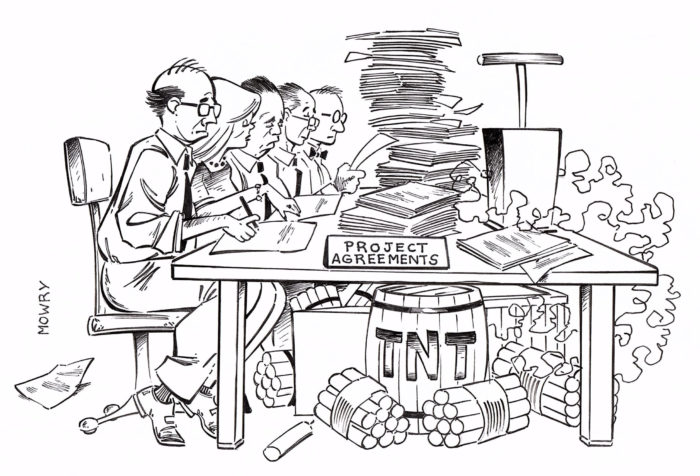
The big political risk in the runup to commercial close for the Calcasieu River Bridge Replacement was a concentrated but very vocal anti-toll campaign. The same anti-toll political risk has recently materialized for the other bridge P3 in Louisiana: the Belle Chasse Bridge project. A key difference: for the Belle Chasse the risk materialized after the project was already complete and tolling operations had begun.
The Belle Chasse Bridge project replaced another old bridge and tunnel across the Gulf Intracoastal Waterway near New Orleans. It was financed in 2019 as a partially toll-funded, revenue risk P3 with a 30-year operating concession. The new bridge opened to traffic in March 2025 and tolling started in May.
After a few months of increasingly vocal opposition to the new tolls, the state suspended them. In October, Governor Landry announced that he was suspending the collection of tolls on the bridge, and DOTD sent a letter to the project’s concessionaire stating the same.
A clause in the Belle Chasse Bridge project agreement gives the state the unilateral authority to suspend tolls on the project. However, according to a draft version of the agreement included in the RFP, such a suspension of tolls is a compensation event for the concessionaire.
The toll opposition for Belle Chasse materialized despite the fact that toll funding was a small portion of the project’s sources – the majority of the project’s $170 million in total costs was covered by federal funding.
The concessionaire for the Belle Chasse Bridge P3 is Plenary Infrastructure Belle Chasse, which is led by Plenary. The design-builder for the project was a joint venture between Traylor Bros. and Massman Construction.
Since the suspension, State Representative Jacob Braud has introduced HB 488, a bill that would require 20 percent of the state’s oil and gas taxes collected in Plaquemines Parish to remain in a fund for the parish. That funding, which would amount to roughly $12 million per year, would then be used to buy out or buy down the Belle Chasse Bridge concession.
HB 488 was passed out of the House Appropriations Committee in April and was then passed by the full House by a 99-0 vote. The legislation is now in the state Senate.
Related Articles

October 2025
Belle Chasse Bridge P3 Tolls Suspended in Louisiana
September 2024
PWF Interview: Shawn Wilson on the IIJA at Three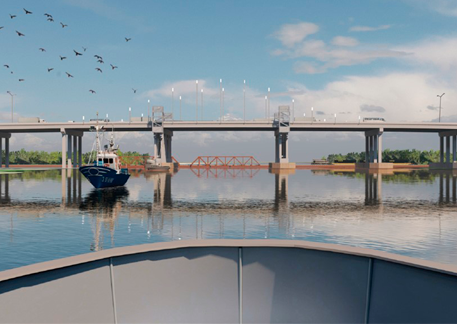
August 2024
Financial Close for Calcasieu River Bridge Project
February 2024
Calcasieu Uncancelled
October 2023
Why We Keep Cancelling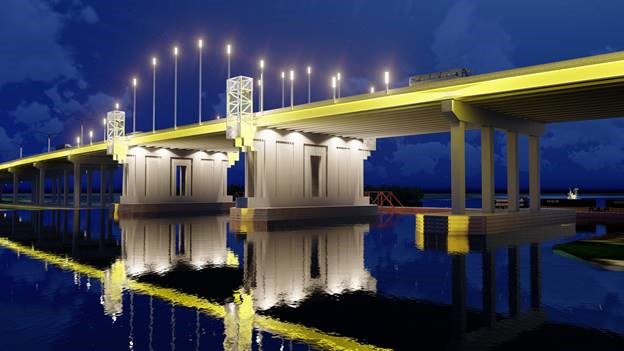
October 2023
Calcasieu Cancelled: Louisiana Legislators Cancel Bridge P3